|
Pre-Colombian
Costa Rica
The most developed pre-Colombian population in Costa Rica was that of the
Chorotegas whose ancestors were from Mexico and migrated to the Nicoya
Peninsula. They left Mexico fleeing pursuers and their name actually
translates to "fleeing people." The Chorotegas lived in cities of as many
as 20,000 people which had central plazas with marketplaces and religious
centers. They were excellent farmers and actually used seeds as currency.
Women worked in ceramics while men farmed or fought in wars, a perpetual
reality in this time. For a complete overview of Costa Rican
cultures
click here »
Military organizations fought to obtain land and slaves, who were
sometimes used as sacrifices, some even thrown into the volcanoes of the
surrounding area. The Chorotegas are also possibly the people who created the enigmatic
granite
spheres that are still seen in many parts of Costa Rica. The artistic
artifacts of these people are many and often beautiful with
ceramics,
carved stone
statues, carved jade figurines, and other exquisite pieces made of
gold. Today,
many examples of their art can be seen in the Jade and Gold Museums.
Colonial Costa Rica
Christopher Columbus actually landed in Costa Rica on his fourth and final
voyage. He did not investigate the country thoroughly but brought back
positive news to Spain about gold and the friendliness of the indigenous
people which encouraged other adventurers to come.
The
first attempt to colonize Costa Rica, (Veragua as Columbus called it), was
made by Diego De Nicuesa. His mission failed miserably as indigenous
peoples along the Atlantic coast burned the land and crops in front of the
advancing invaders and eventually tropical diseases and starvation reduced
the group by half. Nicuesa gave up. The second attempt was made by Juan
Vásquez de Coronado who decided that the central highlands were a more
hospitable location to settle. He founded Cartago, the first Costa Rican
capital, in 1563 and thus began the first real Spanish settlement in Costa
Rica.
In contrast to other colonies, there was no large exploitable workforce in
Costa Rica, as the indigenous population had early on been decimated by
war and diseases brought by the Europeans, and those who were still in the
country lived scattered apart. Therefore, not a lot of Costa Ricans could
gather a quantity of slaves. The lack of
gold and things to be exploited
quickly made the mother country forget Costa Rican colonists and Spain
also refused to invest much money in their future. Costa Ricans, then, had
to work the land themselves in order to survive and were forced against
their dreams of riches, to become a hardworking colony. The self sufficiency that
resulted played a huge part in the making of the Costa Rican people.
Costa
Rica's population grew slowly on its own with little outside influence.
Over time three new cities were founded in the Central Valley: Cubujuquí (Heredia)
in 1706, Villanueva de la Boca del Monte (San José) in 1737, and Villa
Hermosa (Alajuela) in 1782.
Independence
In October 1821, word came that Spain had
granted independence to its American colonies on September 15th. It had
taken news one month to cross the mountains from Guatemala, the central
point of the Spanish empire in Central America. After a brief period of
internal strife, Costa Rica declared itself a state and the capital was
moved from Cartago to San José.
Juan Mora Fernández was an important man in Costa Rica, not only because
he was the country's first president, but also because he set a standard
for the country by concentrating on building roads and schools and most
importantly giving land grants to anyone who would plant coffee. Small
farmers were encouraged to grow coffee and sell the beans to wealthier
farmers, who would prepare the beans for export. The relationship thus was
not one sided and mutual respect was needed and cultivated between rich
and poor, ideals that have generally been held through Costa Rican
history.
Coffee soon became Costa Rica's principal export. Because coffee is a
product best grown in the highlands around the central valley, more and
better quality roads had to be built that led to the coast in order that
the coffee could be sent to the overseas markets. The wealth generated by
coffee also began to bring in investment money from outside the country.
Also, European immigrants trying to earn money, began to arrive. By the
mid-1800's, therefore, Costa Rica had evolved from a self-sufficient and
remote colony into a cosmopolitan state influenced by many European
liberal ideologies.
William
Walker and the Costa Rican Military
William Walker was basically a butcher who
wanted to exploit the possibilities of slavery for his mother country, the
United States. His second expedition into Latin America was to Nicaragua.
He had two main goals. First, convert Central America into a slave
territory and annex it to the southern United States. Second, conquer
Nicaragua and ready it for the construction of a trans-isthmic canal.
Walker failed miserably in his participation in the California Gold Rush
of 1849, but it taught him the difficulty of crossing the U.S. frontier
and the potential value of a sea route; using the San Juan River to travel
up from the Atlantic to Lake Nicaragua and then crossing the lake left
only 18 miles to the Pacific ocean. Walker invaded Nicaragua with 58 men
and held his position until 100's of reinforcements could arrive.
William Walker’s “Filibusters” relax after the
Battle of Granada
William Walker and the battle for Rivas
It
was the Costa Rican people who rose up and overthrew Walker. Eventually a
force of 2,000 men defeated Walker at Rivas, Nicaragua. In the action,
Walker held out in a building. A young boy named Juan Santamaría
volunteered to set fire to the building and succeeded in driving out
Walker and his men. In the action, the boy was killed and became both
Costa Rica's and Nicaragua's national hero by helping to defeat one of the
more hated figures in Central American history.
The United Fruit Company and
The Atlantic Railroad
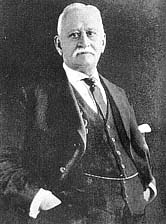 Minor
C. Keith took over the project to build the Atlantic Railroad, originally
started to connect the coffee plantation to the large Atlantic port of
Limón. His idea was not to exploit coffee, but instead to use his power
with investors to complete the railroad in exchange for land in which to
grow bananas. During the building of the railroad, a workforce of
thousands of Jamaican, Italian, and Chinese workers were recruited, a fact
that would change the face of the Costa Rican population permanently. The
railroad was completed in 1890 and until 1970 was the only route from the
central valley to Limón. Minor
C. Keith took over the project to build the Atlantic Railroad, originally
started to connect the coffee plantation to the large Atlantic port of
Limón. His idea was not to exploit coffee, but instead to use his power
with investors to complete the railroad in exchange for land in which to
grow bananas. During the building of the railroad, a workforce of
thousands of Jamaican, Italian, and Chinese workers were recruited, a fact
that would change the face of the Costa Rican population permanently. The
railroad was completed in 1890 and until 1970 was the only route from the
central valley to Limón.
The Jamaicans that Keith and others brought in stayed on the Atlantic
Coast and began to work on the banana plantations that Keith established
on his newly gained lands. Keith and a partner founded the United Fruit
Company, which quickly became a legendary social, economic, political and
agricultural force in Costa Rica and in many other Latin American
Countries. Costa Rica quickly became the world's leading banana producer.
Not only did the company forever change the Costa Rican economy, but it
also changed the face of social relations. Keith and his company were less
than humane in the treatment of their workers, and San José communists
organized the workers to strike against the company. They demanded regular
payment of salaries, free housing, medical clinics and accident insurance
and eventually forced the company to comply. Socialist strains have never
left the country since this action took place.
Liberalism in Costa Rica
The birth of liberalism in Costa Rica came
from the battle between the conservative church and the liberalizing
state. The bishop of Costa Rica criticized the European ideas that were
becoming popular with the elite and the politicians. The bishop was
promptly expelled from the country in 1884 and there was an official
denouncement of an earlier church-state agreement that had declared
Catholicism the state religion. The public outcry against these actions
was minimal.
The new liberal power was realized when for the first time in the history
of Costa Rica real public elections were held in Costa Rica. The liberals
were surprised when the opposition gained overwhelming support, and they
became victims of the very reforms they had implemented. When the liberals
tried to stop the new president from being recognized, 10,000 people
flooded the streets. The people of Costa Rica obviously enjoyed their new
found political power. Since then Costa Rica's democratic tradition has
endured nearly unabated until today.
The 1948 Civil War
Rafael Angel Calderón was the legally
elected president between 1940 and 1944. He was a social reformer and many
of his policies had a positive affect on Costa Rica. He established the
University of Costa Rica, and initiated many social reforms including
social security, workers' rights to organize, land reform, guaranteed
minimum wage, and collective bargaining. The problems started though when,
after his term as president, Calderón ran a puppet candidate (Teodoro
Picado) in an election that was widely criticized as fraudulent. With this
political maneuver, Calderón had made enemies with the poor who originally
had supported him.
In
the next election Calderón himself ran against Otilio Ulate, who
represented the unified opposition. Ulate won the election but it was
close, and was contested by the government. Government forces refused to
yield to Ulate, and Teodoro Picado remained in power.
José
María Figueres led the opposition forces against the government. After 40
days of civil war, during which more than 2000 people died, a negotiated
treaty was signed. Figueres took over as provisional president. He
governed for 18 months and executed some of the most important changes in
Costa Rican history including the prohibition of presidential reelection,
banning of communist labor unions and parties, abolition of the army, the
right to vote for women and blacks, and the establishment of a neutral
body that would oversee elections. All of Calderón's social reforms were
maintained. In 1949, Figueres turned the country over to Ulate, the
rightful president.
Figueres was elected president two times. This was possible because of a
law allowing presidents to be reelected if not in consecutive terms. He
was the only person in Costa Rican history to have done it until 2006 when
Oscar Arias Sanchez returned to office. Figueres is recognized as one of
Costa Rica's greatest political figures and has achieved the status of a
national hero.
History Since 1948
Costa Rica continued its progressive social
policies through the three decades after 1948 and enjoyed a gradual upward
economic trend. The basic policy of the government in the decades after
the 1970's was to become more independent agriculturally, but this
actually caused a heavy dependence on imported goods needed for farming.
Other problems were the continuing drop in the prices of coffee, bananas,
and sugar. Costa Rica had also taken out loans to improve its
infrastructure and when these loans came due, Costa Rica could not pay and
soon its economy was in shambles. Magnifying the country's problems was
the instability of Nicaragua and Panama, which did nothing else but hurt
Costa Rica. The reputation of Central America as a place of violence and
poverty stopped much potential investment. Also, Costa Rica's status as
one of the wealthiest third world countries brought a flood of immigrants
from its two neighboring countries, taking jobs and money out of the
country.
Oscar
Arias was elected president in 1986. One of his primary goals was to work
for peace in Central America. As is well known by now, Arias' efforts
gained him the 1987 Nobel Peace Prize. Many Costa Rican's have varying
opinions about Arias' job as president of Costa Rica, but his efforts in
Central America have certainly had a profound effect on the region's
outlook. Many Latin Americans feel that the wars that have shredded apart
the region have finally ended, and that this gives them the opportunity to
unite their futures in a new and profitable direction.
José María Figueres was one of the youngest Presidents in history. He
worked with a group of elite, mostly foreign-educated experts who occupy
governmental posts. He promised to remedy the problems facing the poor,
but the same forces that have frustrated Costa Rica's economic programs
for years are undermining his. For years administrations have tried to
implement the "structural adjustment programs" recommended for Latin
America by international institutions . Though maintaining a relatively
low level of unemployment, the privatization of much of Costa Rica's
public sector, and the slashing of government jobs have recently caused
some of the bitterest strikes in Costa Rican history.
The public infrastructure has deteriorated, from schools to roads, and the
rural and urban poor have felt that they are being ignored. Small farmers
are feeling the pain of mono-crop plantations owned by wealthy
corporations, and what was once the heart of the Tico economy and
lifestyle is disappearing.
Miguel Angel Rodríguez took office in mid-1998 and faced the same
challenges as his predecessor.
In 2006 Oscar Arias was reelected president in a close contest. Though he
is popular from his past work, he is in support of an international trade
agreement that many Tico's feel to be in conflict with their needs.
It is clear that change is necessary, but of course, the transition is
painful. Costa Rica is seen as an interesting test site for a Latin
American economy that is trying to make the transition to a globalized
world. Dr. Tim
McGuinness
October 2007 |
Recommended Costa Rican
Precolumbian Websites:

Costa Rican Products:
|